

When It Comes to Enterprise Tech, Your Architecture Dictates What Scales
The structural choices you make today determine whether your capabilities can scale or become rigid, long-lived dependencies.

AI has made experimentation remarkably easy. Prototypes that once took months can now take days. Models can be accessed through an API, agents assembled quickly, and new capabilities added to existing applications.
Enterprise scale, on the other hand, remains stubbornly difficult.
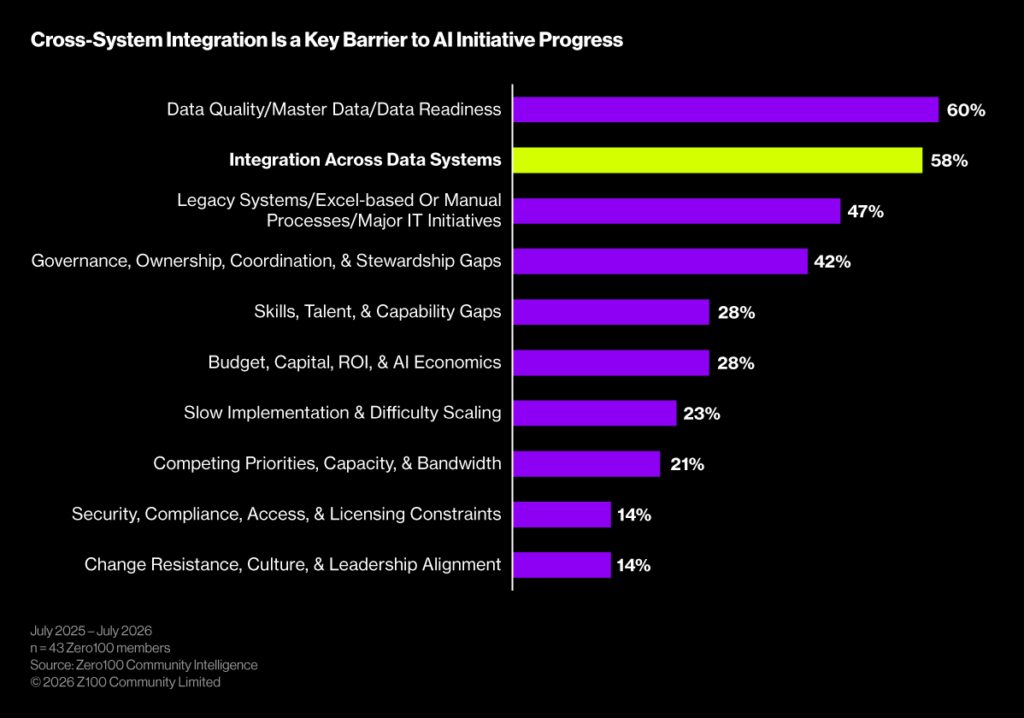
We often treat scaling as a deployment problem. But the harder test comes when the work crosses application or functional boundaries. In fact, our analysis found 58% of companies identify cross-system integration as a key barrier to AI progress.
The same intelligence now needs to support another decision, draw on context held elsewhere, or trigger an action in a different system.
This brings us to our third principle of modern enterprise technology: architecture determines what scales.
When a Product Decision Becomes an Architecture Decision
We saw this recently while working with a global pharmaceutical company on connected workflows and its agentic AI roadmap.
The team asked us to help assess providers for a product lifecycle management (PLM) upgrade, which, on the surface, seemed like a straightforward vendor decision.
But when we mapped out the actual work, we realized the decision went much deeper. A product change didn’t end in PLM. It also needed to trigger downstream planning decisions, such as when to phase out existing materials, introduce replacements, and adjust inventory requirements.
At that point, picking a vendor took a backseat to a much bigger question: where should this capability actually live?
The organization now had to weigh its options: Should the capability connecting product changes to downstream material and inventory planning sit inside PLM? Could they extend an existing platform? Should they build it themselves, or bring in a partner? Each choice created different boundaries around where intelligence could travel, where the capability could be reused, and what remained under enterprise control.
Build, buy, partner, or extend turned into an architecture decision before it became a sourcing decision. The evaluation now included whether the existing planning platform could support the capability, without the assumption it needed to be delivered through a PLM upgrade.
Architecture Sets the Boundary of Scale
Last week, we established that reuse is what makes enterprise capabilities truly valuable. The catch is that your architecture determines how far that reuse can travel.
Intelligence embedded within one application may scale extremely well there. But when another workflow needs the same capability, the enterprise may have to recreate its integrations, context, or business logic. This comes down to where the data, intelligence, and business logic sit; their exposure to other systems; and whether they can be reused without rebuilding.
Design the capability so it can be consumed elsewhere, however, and the boundary changes.
There is no universally right architecture. Keeping a capability within a platform may provide speed, domain depth, and attractive economics. Internalizing more of it may unlock reuse across applications. Or, extending something already sitting in your tech estate could be the most sensible answer.
Either way, the architecture you choose today will dictate which options remain open tomorrow.
Modernization Can Take Different Forms
We see this when comparing organizations with similar ambitions but very different starting points.
One company we worked with had a fragmented legacy estate and constrained capital. Wholesale replacement wasn’t the answer. Instead, the highest-value path was connection: they preserved core applications, linked selected outputs, protected critical data, and deferred major platform upgrades while the technology landscape evolved.
Another Zero100 member was already undertaking a significant technology transformation, with investment and executive sponsorship behind it. Its constraint was fragmented enterprise context. For them, greater internalization made sense: building shared data, semantics, and intelligence capabilities to act as a common foundation for multiple applications and workflows.
Both companies were modernizing, but their approaches looked completely different.
The takeaway is that architecture isn’t a maturity ladder. The right design depends on the estate you have, the economics you’re working within, and where your capabilities need to scale.
Preserve Choice Where Technology Is Moving Fastest
All of this matters because different parts of the technology stack have different structural durability.
Models and providers can be moved and adapted quickly. But data relationships, business context, operating logic, and institutional knowledge are more deeply entrenched.
Tying those more durable capabilities too closely to fast-moving technologies can turn a short-term technology choice into a much longer-term dependency.
We use a simple rule of thumb: the model should be able to change without the enterprise having to relearn itself.
The same logic applies beyond models. Providers can change without rebuilding enterprise context; applications can evolve without recreating critical business logic; new workflows can draw on capabilities you’ve already built instead of starting from scratch.
Ultimately, the right architecture creates scale by preserving that optionality.
What Should I Do Now?
- Follow the capability beyond the application. Before committing to a platform or provider, ask your technology team to show where the capability needs to operate, which systems it depends on, and where the underlying data, context, and business logic will sit.
- Test the next use case. Ask providers to demonstrate how another workflow could use the same capability, what would need to be rebuilt, and what happens if an underlying platform or model changes.
The choice of technology provider still matters. But it increasingly sits within a broader architectural decision.
Related Insights


