

Token Scorecards Could Be Key to Winning with AI in Supply Chain
Tracking units of compute turns AI spending from a black box into a precision tool for scaling ROI.

Iwas part of a supply chain innovation event ten years ago where a data specialist from McLaren Racing detailed how their Formula 1 team used massive amounts of data to analyze pit crew movements. The goal was speed. The tool was an ultra-fine slice measurement of work inputs using data from cameras and sensors in and around the car and pit area.
Supply chain people in the audience loved it, imagining what they might do with that kind of data and analytical horsepower. Maybe now, with token economics, we can stop imagining and start doing it.
Tokens Allow You to Measure Compute Effectiveness
NVIDIA sums it up simply: “AI runs on tokens.” Their overview of token utility is a helpful guide to understanding how different model types, context loads, intelligence modes, and response times affect token costs. Cutting-edge LLMs from the frontier labs might have a 400x larger token budget for context setting compared to a narrow-purpose SLM from an open-source provider. Of course, you get what you pay for, and it’s up to the user to decide whether to spend millions of tokens for an output.
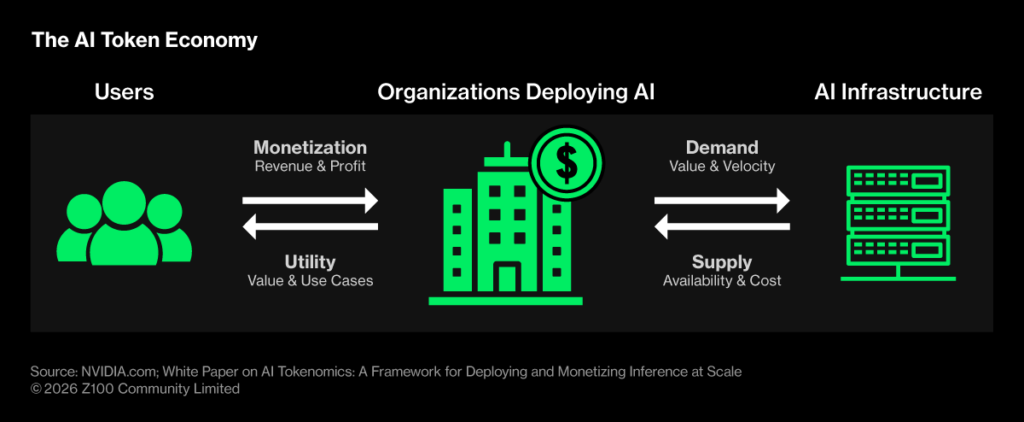
At a recent Zero100 roundtable of two dozen supply chain leaders, one manufacturing executive detailed the value of AI in plant operations. His example was a winner because lightweight AI tools were chosen, matching the problem statement, which was to find the right troubleshooting procedures from a big library of maintenance documentation. He “didn’t want to use a sledgehammer to kill a mosquito.”
If compute effectiveness is the goal, tokens are the right unit of measure.
It’s About People, Not Just ROI
What if your CFO issued a mandate to cut token use by 50%?
Recent news stories on tokenmaxxing have gotten attention as organizations eager to show fast AI adoption are churning through massive amounts of compute. As a line-item expense, tokens are still small for most, but as a measure of compute effectiveness, they show huge variation in the way individuals and teams spend resources to do their work.
At Zero100, we internally track tokens by user for our suite of AI tools built for research, data analytics, and workflow automation. Usage patterns differ dramatically, partly because people work in different ways, but also because tasks require a range of data analysis types, and because the tools themselves are constantly being improved.
The benefit of looking at our token scorecard is seeing how individuals use the tools to do their work and correlating that detail with the quality of the work. We get precise, real-time intelligence about who is using compute effectively and what tools offer the best bang for buck. If our CFO wants to trim token spend, we can specify what’s worth keeping and what’s not, while also tracking how our team is adopting AI for business benefit.
It’s Also About Agents
AI for supply chain leaders is increasingly focused on agentic workflows that streamline tasks across functions (aka PowerThreads). Examples from leading companies like Walmart, PepsiCo, and Pfizer combine subtasks done both by agents and people, from digesting demand signals to setting inventory levels and launching production runs. Where these tasks use AI tools to make decisions, token consumption is measured.
Again, the value of a token scorecard is all about how leaders can get granular about which agents are working well and what tools they need to deliver. In a continuous improvement mode, this means process design, metrics selection, and even master data can be optimized with some precision in real time.

Token budgets for most Fortune 500 supply chain organizations may still be less than $1 million, but the intelligence token data provides will be critical to get value for money on all other AI project expenses.
Visibility Matters
The vital question of 2026 has been how to scale AI ROI for payback. Test-and-learn was fine for a while, but the new challenge is to use AI and agentic systems with precision to increase enterprise value. Token scorecards are a data goldmine that leaders should use to deeply understand compute effectiveness so they can scale smart.
This race is for all the marbles.
Related Insights

NVIDIA’s Shake-Up Is Just the Latest Reason to Ask Who Owns Your Compute
Read More →
Inflation, Demand Destruction, and the Lean Supply Chain Paradox
Read More →